
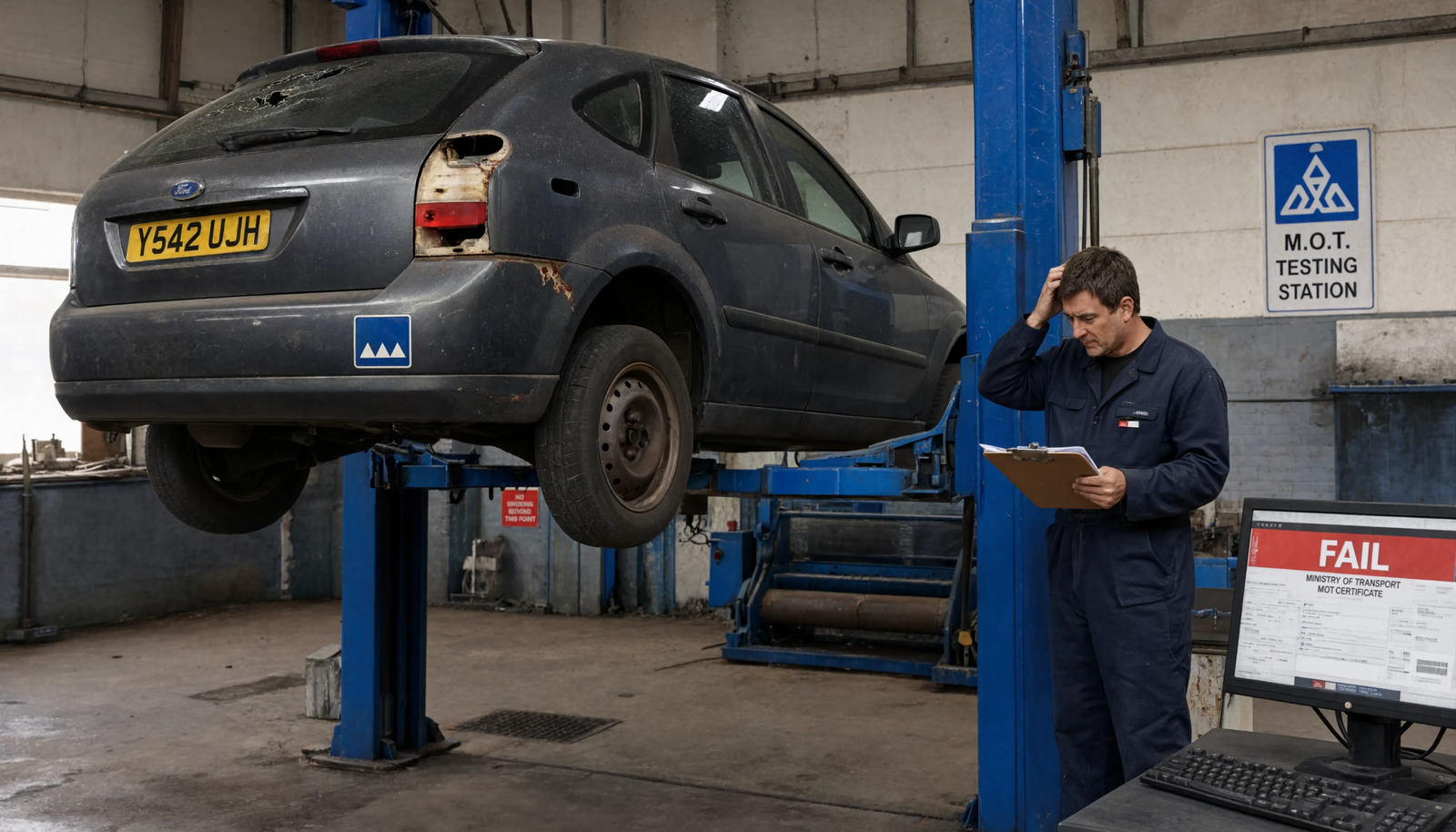
An MOT failure sheet can look alarming, but it’s really just a list of things the tester found, sorted by how serious they are. A failure means at least one item was marked “dangerous” or “major”, which must be put right for the car to pass. Not every item on the sheet is a disaster, some are cheap and quick, and the “advisory” notes aren’t failures at all, just things to keep an eye on. Understanding what the sheet is telling you is the first step to deciding what to do.
This guide explains the MOT result categories in plain English, what the common failure items mean and which are genuinely serious, what to do when your Ford fails, and how to judge whether the failure is worth fixing.
What an MOT failure actually means
An MOT tests whether your car meets the minimum legal standards for safety and emissions on the day of the test. If everything’s within standard, it passes. If something isn’t, it fails, and the tester records why.
A “failure” simply means the car has at least one dangerous or major fault that has to be fixed before it can pass and legally be driven (outside the limited exceptions). It doesn’t automatically mean the car is finished, or even that the repair is expensive, that depends entirely on what failed.
The sheet you get lists every issue found, each tagged with a category. Reading those categories is how you tell a cheap, quick fix from a serious problem.
The MOT result categories: dangerous, major, minor, advisory
Since 2018, MOT results have used these categories, and knowing them tells you most of what you need:
Dangerous. A direct and immediate risk to safety or the environment. This is a failure, and you must not drive the car until it’s repaired, not even away from the test centre in the normal way. It’s the most serious tag.
Major. A fault that could affect safety or the environment, or the car’s roadworthiness. This is also a failure and must be repaired for the car to pass, but it isn’t tagged as an immediate danger the way “dangerous” is.
Minor. The car still passes, but there’s a fault worth attending to before it worsens. A minor is not a failure, it’s a note to sort something soon.
Advisory. The tester’s heads-up that something is starting to wear or may need attention in future, for example a tyre getting low or slight corrosion beginning. An advisory is not a failure and doesn’t need immediate action, but it tells you what’s coming.
So the quick read is: dangerous and major are the failures you must fix; minor and advisory are warnings, not failures. If your sheet only has minors and advisories, the car actually passed.
Worth knowing. The advisories are the most useful and most ignored part of an MOT. They’re a free forecast of what’s likely to fail next year, tyres wearing, corrosion starting, a bush perishing. Reading them and planning ahead turns next year’s “surprise” failure into something you saw coming. On an older Ford, the advisory list is worth as much as the pass itself.
The common MOT failure items, and which are serious
MOT failures fall into a handful of common areas. Some are cheap and routine; others are the ones that can end an older car.
Usually cheaper, routine fixes:
Lights and bulbs, a blown bulb is one of the most common and cheapest failures.
Tyres, worn below the legal limit or damaged, a straightforward if not always cheap replacement.
Wipers and washers, minor and inexpensive.
Brake pads worn, a routine wear item.
Potentially serious, cost-depends items:
Brakes, beyond pads, discs, lines or imbalance can be more involved.
Suspension, worn components, springs or mounts, labour can add up.
Emissions, especially on diesels, often linked to a DPF issue, which can be costly. See our DPF guide.
The ones that can end an older car:
Structural corrosion, rust on the sills, subframe or suspension mounts. This is the big one on older Fords, and it’s covered fully in our corrosion and MOT rust guide, because welding often costs more than the car’s worth.
The point is that “failed its MOT” covers everything from a £10 bulb to a car-ending rust failure. The category tags and the specific items tell you which end of that range you’re at, so never assume the worst (or the best) until you’ve read what actually failed.
What to do the moment your Ford fails
A calm, simple sequence:
Read the sheet properly. Note which items are dangerous or major (the actual failures) versus minor or advisory (the warnings).
Ask the garage to explain and quote. Get a clear idea of what each failure item involves and what it’ll cost to fix. A good garage will talk you through it.
Separate the cheap from the serious. A fistful of small items (a bulb, a wiper, a tyre) is very different from one big structural or mechanical failure, even if the sheet looks long.
Compare the total against the car’s value. This is the decision point, covered below.
Don’t rush into repairs, or into scrapping, before you understand the sheet. A long-looking failure list can be mostly cheap items, and a short one can be a single expensive killer.
Can you drive a car that’s failed?
Briefly: if a car has failed and its previous MOT has also expired, you generally can’t drive it on the road except to a pre-booked MOT or to a garage for repairs, and not at all if it has a dangerous item. The exact rules are set by gov.uk and DVSA, so check there.
If you’re selling the car rather than repairing it, this becomes a non-issue when you sell to a buyer who collects, the car goes on a transporter and never needs to be driven. Our guide on selling a Ford that’s failed its MOT covers that side in full.
Repair or move on? Judging the failure
Once you understand the sheet, the decision is the familiar one: weigh the cost of the failures against the car’s value.
If the failures are cheap and routine, bulbs, a tyre, wipers, pads, on an otherwise sound car, fixing them and carrying on is almost always right.
If there’s a single serious failure (major suspension, brakes, emissions) on a car that’s otherwise good and worth well above the repair, it’s usually still worth fixing.
If there are multiple serious failures at once, or structural corrosion, and the total approaches or exceeds the car’s value, that’s the point where repairing an older Ford often stops making sense. Our guide on whether it’s worth repairing your Ford walks through the comparison.
The key is that the MOT sheet gives you the information; the decision comes from setting the real repair cost against what the car’s actually worth.
When a failure marks the end of the road
Sometimes an MOT failure is genuinely the end for an older Ford, usually when the failures are serious (especially corrosion), several are stacked together, and the total to fix them is more than the car is worth. There’s little sense pouring a car’s-worth of repairs into a car that will still be old and near its next set of failures.
If you reach that conclusion, a failed-MOT Ford still holds real value in its sound parts, the engine, gearbox, interior, electronics and good panels, well above scrap. We buy Fords that have failed their MOT, running or not, and value them on what’s genuinely left. We collect free (so the car never has to be driven or tested), handle the DVLA paperwork, and pay by bank transfer. See how it works on our Kent and Essex pages.
And if the failures turn out to be minor and cheap, the car likely has plenty of life left, in which case fixing them and keeping it is the obvious call.
Frequently asked questions
What does it mean if my car fails its MOT? It means the tester found at least one dangerous or major fault that must be fixed before the car can pass and be legally driven. It doesn’t necessarily mean the car is finished or the repair is expensive, that depends on what failed. The sheet lists each item with a category showing how serious it is.
What’s the difference between dangerous, major, minor and advisory on an MOT? Dangerous and major are failures that must be fixed to pass; dangerous means an immediate risk, so you mustn’t drive the car at all. Minor and advisory are not failures, minor is something to sort soon, and advisory is a heads-up about future wear. A sheet with only minors and advisories means the car passed.
What are the most common MOT failures? Lights and bulbs, tyres, wipers, brakes and suspension are among the most common, along with emissions on diesels and corrosion on older cars. Bulbs and wipers are cheap; corrosion and some brake, suspension or emissions issues can be expensive.
Should I fix my car after it fails its MOT? It depends on the cost of the failures versus the car’s value. Cheap, routine items on a sound car are worth fixing. Multiple serious failures or structural corrosion that cost close to or more than the car’s worth often aren’t, and selling may make more sense. Get the failures quoted and compare against a valuation.
Are MOT advisories something to worry about? Not immediately, they’re not failures. But they’re a useful forecast of what may fail next time, so it’s worth reading them and planning ahead, especially on an older car. Ignoring advisories is how next year’s failure becomes a surprise.
Can I sell a Ford that’s failed its MOT? Yes. You don’t need a valid MOT to sell a car, and a specialist buyer who collects it means it never has to be driven or tested. Even a car that’s failed on something serious still holds real value in its parts.