
Rust can fail an MOT, but only when it’s in the wrong place or bad enough to matter. Corrosion on a structural part of the car, or on certain prescribed areas near important components, is an MOT failure; light surface rust on a non-structural panel usually isn’t. The trouble is that rust works out of sight, underneath the car, so the first many owners hear of it is a failed MOT, and by then the repair can cost more than the car is worth.
This guide explains when rust fails an MOT, where Fords tend to corrode, how to spot it early, the crucial difference between surface and structural rust, why welding is so expensive, and how to judge when corrosion has ended a car’s useful life. It’s written for owners, not mechanics.
Will rust fail an MOT?
Sometimes, and it depends entirely on where the rust is and how bad it is.
Corrosion causes an MOT failure when it affects a structural part of the car, or a prescribed area near a critical component like a suspension mount, brake line, steering part or the seatbelt anchorages. In those areas, significant corrosion is a safety issue, so it fails.
Light surface rust on a non-structural panel, a bit of bubbling on a wing or door, generally isn’t an MOT failure on its own, though it may be noted as an advisory. It’s cosmetic rather than dangerous.
So a car can have visible rust and still pass, or have little visible rust and fail on something corroded underneath. The MOT is concerned with corrosion that affects safety and structure, and the official DVSA inspection standards set out exactly how it’s assessed.
Why rust is the quiet killer of older cars
Rust is different from a mechanical fault, and that difference is what catches owners out.
An engine, a gearbox or a clutch gives you warning: a noise, a light, a change in how the car drives. You get a heads-up. Rust gives you nothing. It works slowly and silently, underneath the car where you never look, on the sills, the subframe, the brake lines and the suspension mounts. There’s no dashboard light for corrosion.
That’s why the first sign is so often a failed MOT, arriving with no warning at all. The car drove in fine and it’s failed on something structural you never knew was there. And because rust doesn’t fix itself and only spreads, a car that’s started to corrode structurally is usually on a downward path.
This quiet, no-warning nature is exactly why corrosion is one of the most common reasons an older Ford reaches the end of its life. It doesn’t announce itself, and by the time it does, it’s often serious.
Where Fords tend to rust, and how to spot it early
Like most cars, Fords tend to corrode in predictable places, usually where road salt, water and debris collect. Worth checking, or having checked, on an older car:
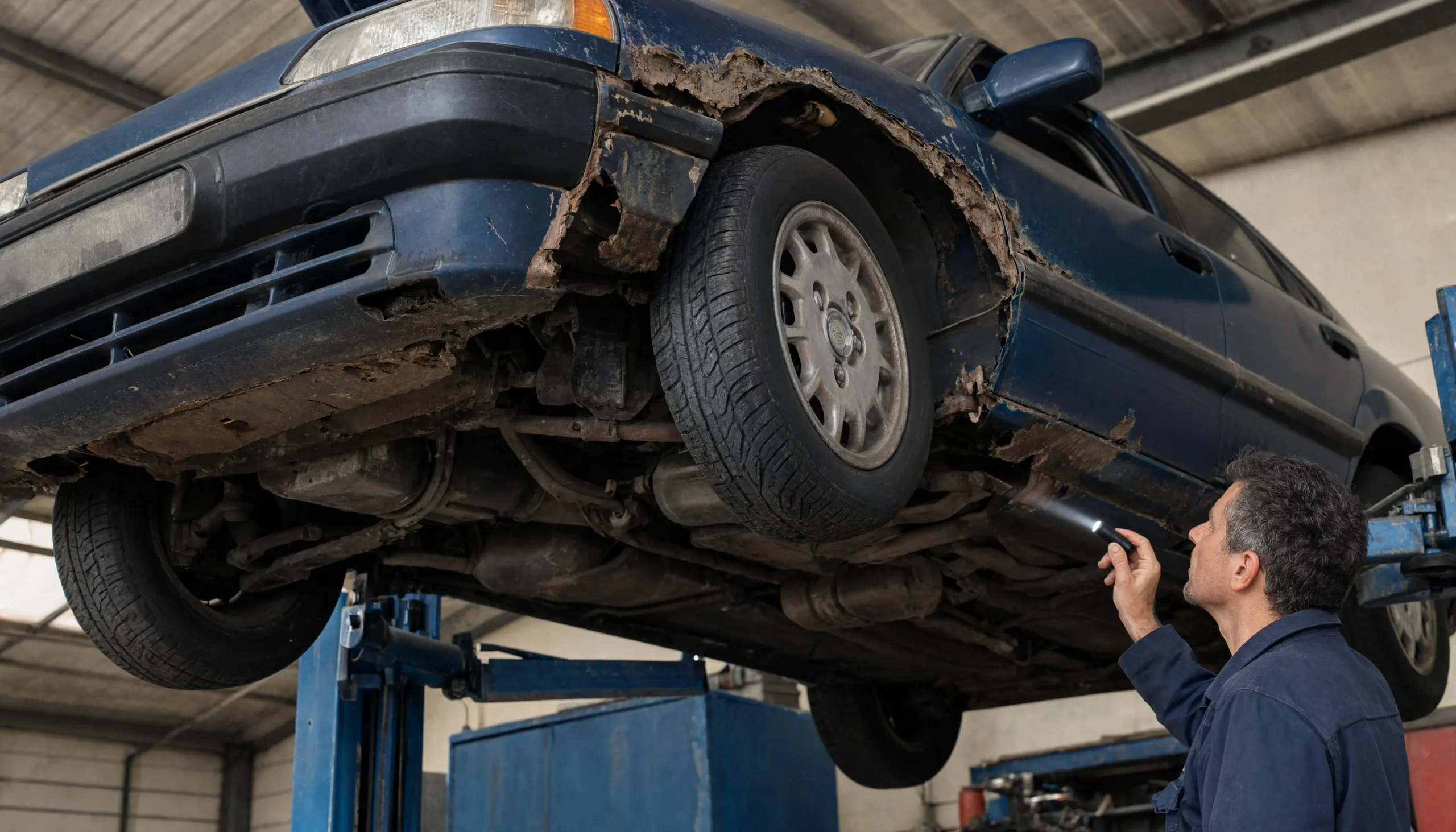
The sills, the structural sections along the bottom of the car below the doors, a common and important area.
The wheel arches, where stones and salt spray attack the metal.
Underneath, the subframe, floor, suspension mounts and brake lines, the areas that matter most for the MOT.
The rear suspension mounting areas and boot floor on some models.
Around the fuel and brake lines, which can corrode where they run underneath.
To spot it early: on an older Ford, take a look underneath (or have a garage check) once a year, ideally before the MOT is due. Look for flaking, scabbing, bubbling paint underneath, or metal that sounds or feels soft. Catching corrosion while it’s minor gives you options; discovering it as an MOT failure gives you fewer.
Worth knowing. The best time to find out about corrosion is before the MOT, not on the day it fails. A quick underneath check a few weeks ahead, especially on a car over about eight years old or one that’s lived near the coast or on salted roads, tells you what’s coming and lets you plan, rather than being landed with a failure and a decision on the spot.
Surface rust vs structural rust: the crucial difference
This is the distinction that decides everything, so it’s worth being clear.
Surface rust is cosmetic. It’s the bubbling, scabbing or discolouration on the outer panels, wings, doors, bonnet edges. It looks unsightly, but it isn’t a safety problem and usually isn’t an MOT failure. Left alone it can spread, but in itself it doesn’t threaten the car’s structure.
Structural rust is the serious kind. It affects the parts that give the car its strength and safety, sills, subframe, suspension mounts, and the areas around critical components. This is what fails MOTs, and it’s what can end a car, because it can’t safely be ignored and it’s expensive to put right.
The reason this matters: a rusty-looking car isn’t necessarily a write-off, it might just have surface rust on the panels. And a clean-looking car isn’t necessarily sound, it might be corroding underneath. Judge the car by where the rust is, not just how rusty it looks.
Why welding repairs cost so much
When structural rust does need fixing, owners are often shocked by the cost, so here’s why.
Repairing structural corrosion means cutting out the rotten metal and welding in new, done to a proper standard so the repair is sound and safe. That’s skilled, labour-intensive work. It’s not a case of filling or painting; the affected section has to be properly reconstructed.
On top of that, rust rarely comes alone. Where one area has corroded, the areas around it are often going the same way, so a repair can uncover more than expected, and today’s fix may be followed by another next year.
Put those together, high labour, and the tendency for rust to be more widespread than it first appears, and structural welding on an older car frequently costs more than the car is worth. That’s the hard economic reality that makes corrosion such a common end-of-life point for older Fords.
Slowing corrosion down
You can’t stop rust entirely on an older car, but you can slow it and give the car a longer life:
Wash the underneath, especially through winter and if you’re near the coast or on salted roads. Getting salt off the car is one of the most effective things you can do.
Keep on top of small stone chips and surface damage, where bare metal is exposed, before they take hold.
Consider underbody protection or rustproofing on a car you plan to keep, applied properly it can slow corrosion in vulnerable areas.
Don’t leave a car standing unused for long periods in a damp spot, which accelerates corrosion.
Have the underneath checked yearly, so you catch problems while they’re small.
None of this reverses existing rust, but on a sound car it can meaningfully delay the corrosion that would otherwise end it. Our guide on Ford servicing and keeping an older car healthy covers the wider maintenance picture.
When corrosion means the car has reached the end
Sometimes corrosion is the point where an older Ford stops being worth keeping, and it’s worth recognising that honestly.
If your Ford has failed its MOT on structural corrosion, and the welding needed costs a large share of, or more than, the car’s value, and especially if there’s more rust visible elsewhere, that’s often the end of the road. Spending heavily to weld an old car that will still be old, and rusting, afterwards rarely adds up. Our guide on whether it’s worth repairing your Ford helps you weigh it.
If you reach that point, a rusty Ford still has real value in the parts that aren’t affected, the engine, gearbox, interior, electronics and good panels. We buy Fords that have failed on corrosion, running or not, and value them on what’s genuinely left rather than a scrap price. We collect free across the UK, handle the DVLA paperwork, and pay by bank transfer, so a car that’s failed on rust doesn’t have to become a problem to dispose of. See how it works on our Kent and Essex pages.
And if the corrosion turns out to be surface rust rather than structural, the car may have plenty of life left, in which case keeping it is the sensible call.
Frequently asked questions
Will rust fail an MOT? It depends where it is. Corrosion on a structural part, or in a prescribed area near a critical component like a suspension mount or brake line, is an MOT failure. Light surface rust on a non-structural panel usually isn’t, though it may be noted as an advisory.
What’s the difference between surface rust and structural rust? Surface rust is cosmetic, bubbling or scabbing on outer panels, and usually not an MOT failure. Structural rust affects the parts that give the car strength and safety, like the sills, subframe and suspension mounts, and it fails MOTs and is expensive to fix.
Where do Fords usually rust? Commonly the sills, wheel arches, and underneath, the subframe, floor, suspension mounts and around the brake and fuel lines. These are the areas where salt, water and debris collect, and the underneath areas are the ones that matter most for the MOT.
Why is welding rust repair so expensive? Because it means cutting out the corroded metal and welding in new to a proper standard, which is skilled, labour-heavy work. Rust also tends to be more widespread than it first looks, so repairs can uncover more, making the total cost high, often more than an older car is worth.
Can I stop my Ford from rusting? You can’t stop it entirely on an older car, but you can slow it: wash the underneath (especially in winter and near the coast), deal with stone chips early, consider underbody protection, avoid leaving it standing in damp conditions, and have the underneath checked yearly to catch problems early.
Is a Ford that’s failed its MOT on rust worth anything? Yes. Even a corroded Ford holds real value in the parts that aren’t affected, the engine, gearbox, interior and good panels. A specialist values it on what’s genuinely left rather than a flat scrap price, so it’s usually worth more than you’d expect.