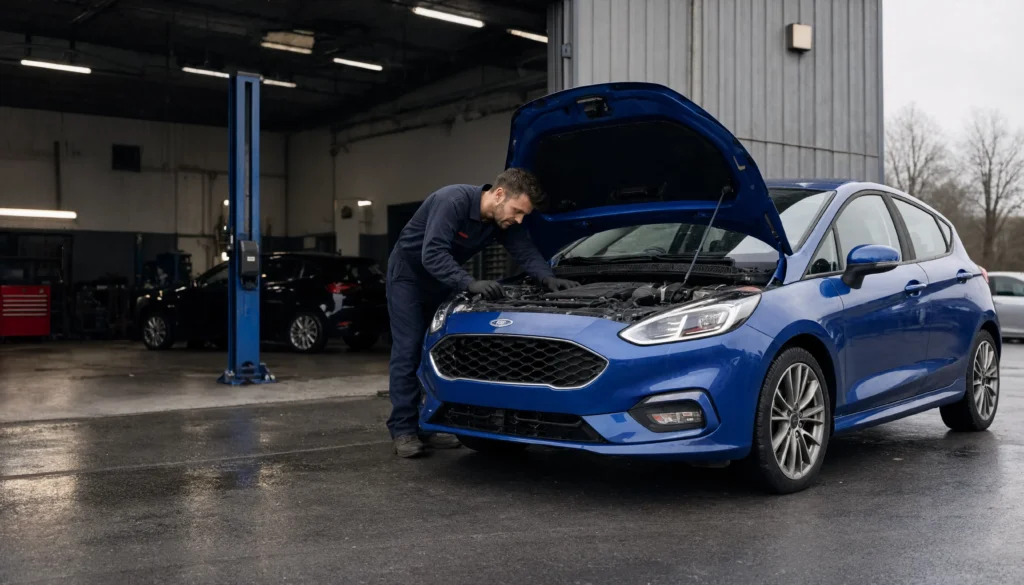

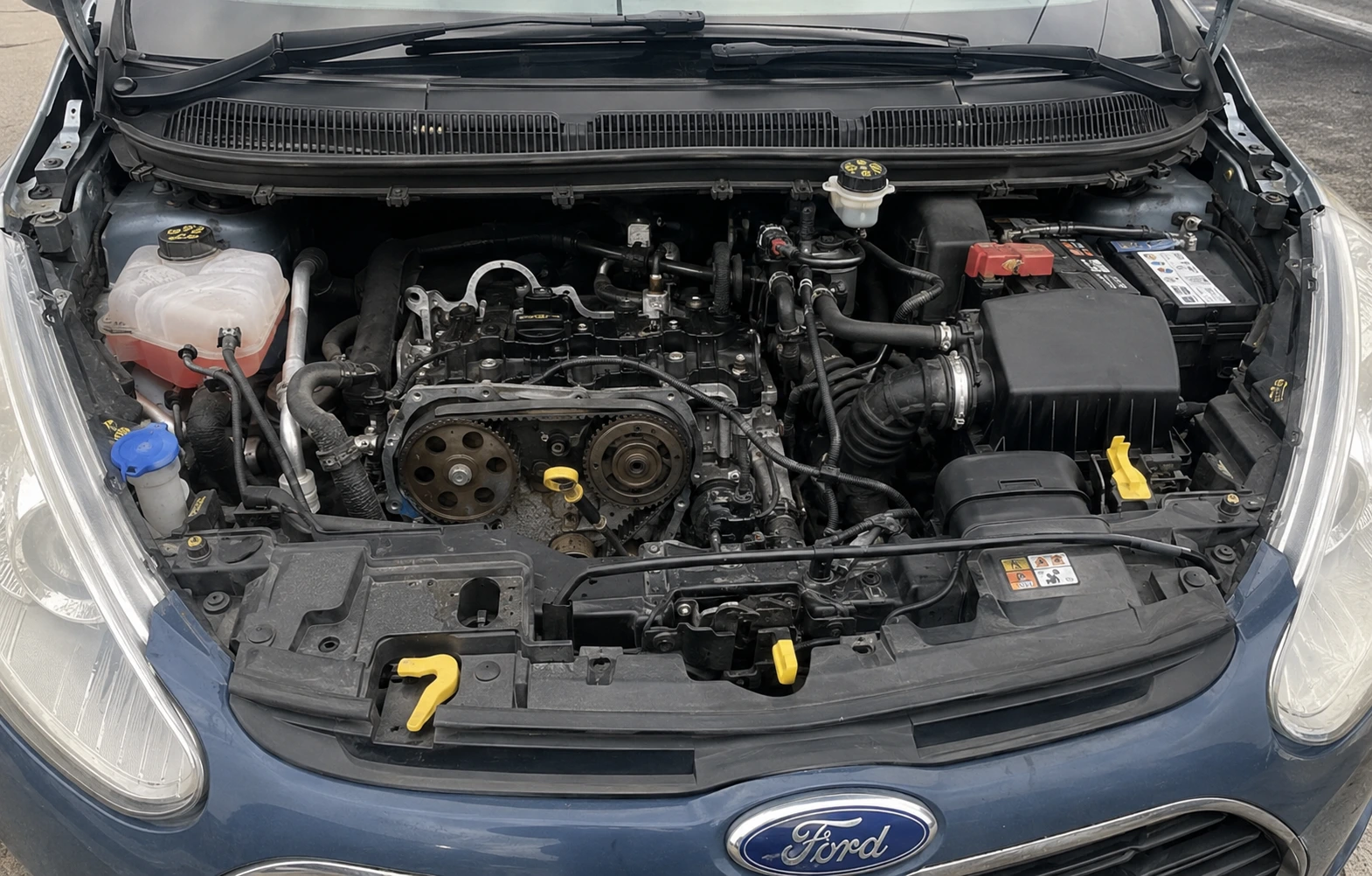
A wet belt is a timing belt that runs inside the engine, bathed in oil, instead of outside it. Ford fits one to its 1.0 EcoBoost petrol engines, found in the Fiesta, Focus, Puma and others. It works well when it’s healthy, but as it ages it can break down, and if it fails it can destroy the engine. That combination, a part hidden inside the engine that’s expensive to replace and dangerous when it goes, is why “wet belt” has become a phrase Ford owners dread.
This guide explains what a wet belt is, which cars have one, how to spot trouble early, what a repair actually costs, and how to decide whether fixing it is worth it. No jargon, and no scaremongering, just what you actually need to know.
What is a wet belt, and why does it matter?
Most people picture a timing belt (or cambelt) as a toothed rubber belt on the outside of the engine, driving the camshafts and keeping everything in sync. For decades that’s exactly what it was, and changing one was a known, budgetable service job.
A wet belt does the same job, but it lives inside the engine and runs in the engine oil. Ford’s version is properly called a “belt in oil” system. Running the belt in oil is meant to reduce friction and noise and help the belt last longer.
The catch is what happens as the belt ages. The rubber can start to break down, and tiny particles of it come away and mix into the oil. Those particles can then block the oil pickup, the strainer that feeds oil to the engine. Starve an engine of oil and it destroys itself in short order. So a failing wet belt isn’t just a worn belt, it’s a threat to the whole engine.
Why Ford uses a wet belt in the first place
It’s worth understanding this, because it explains why the problem exists at all and why it isn’t simply a “fault” in the usual sense.
Running a belt in oil, rather than a dry belt or a metal timing chain, let Ford build a compact, efficient, quiet engine that met tightening emissions and fuel-economy rules. The 1.0 EcoBoost was a genuinely clever, award-winning engine, and the wet belt was part of what made it work.
The problem is one of ageing and maintenance rather than bad design on day one. A wet belt is fine while it’s within its service life and the oil is kept clean and correct. The trouble comes when the belt gets old, when servicing has been skipped or stretched, or when the wrong oil has been used, because the belt degrades faster in those conditions. That’s when the particles start coming off.
Worth knowing. A wet belt is a service item with a replacement interval, not a “fit and forget” part. A lot of the failures we see come down to the belt simply being older than it should be, or the car having missed the recommended belt change. Keeping to the service schedule genuinely matters on these engines.
Which Ford engines and models are affected
The engine to watch is the 1.0 EcoBoost petrol, Ford’s small turbocharged three-cylinder. It has been fitted across a wide range of Fords, so the wet belt affects a lot of cars on UK roads.
The most common are:
The Ford Fiesta, by far the most numerous, since it was Britain’s best-selling car for years and the 1.0 EcoBoost was a hugely popular engine choice in it.
The Ford Focus, which uses the same engine family and sees the same issues.
The Ford Puma, the newer small SUV, which shares the 1.0 EcoBoost and is now reaching the age where wet belt problems start to appear.
The Ford EcoSport, B-Max, C-Max and some Mondeo variants also used versions of this engine, so they can be affected too.
It’s worth being clear about what is not affected. Diesel Fords, and Fords with a timing chain rather than a belt, don’t have this specific wet belt issue (though they have their own maintenance needs). If you’re not sure what your car has, the registration and a quick check of the engine details will tell you, or any garage can confirm it.
Common misconception. “It’s only the early cars.” Not quite. Because a wet belt degrades with age and mileage rather than to a fixed failure date, newer cars aren’t immune, they just haven’t got there yet. As the Puma and later Fiestas age, more of them are reaching the danger zone. The issue tracks the belt’s condition, not the registration year.
The warning signs of wet belt trouble
This is the part worth reading closely, because catching a wet belt before it fails completely is the difference between a repair and a new engine.
Look and listen for:
A rattle or whine on start-up, particularly a chattering noise in the first moment after a cold start, which can indicate the belt or the oil system struggling.
The oil warning light, or any low oil pressure warning. Never ignore this on an EcoBoost. If the light comes on, stop as soon as it’s safe, because it can mean the oil pickup is starting to block.
Losing oil with no obvious leak. If the car is using oil and there’s nothing on the driveway, get it looked at.
A check engine light, rough running, or a noticeable loss of power, which can accompany timing or oil-supply problems.
Oil that looks contaminated or gritty when checked, or a service that flags debris in the sump.
If you notice any of these on a 1.0 EcoBoost, treat it as urgent rather than something to book in next month. The failures that destroy engines are very often the ones where an early warning was missed.
Worth knowing. If your car is due, or overdue, its wet belt change and you’ve noticed any of the above, don’t drive it any more than you have to. The cheapest possible outcome is replacing the belt before it breaks up. Every mile driven on a failing belt risks turning a four-figure belt job into a much larger engine job.
Why a wet belt job costs so much
Here’s where owners get a nasty surprise, because a wet belt is far more expensive to change than the old-style external cambelt most people remember.
The reason is access. Because the belt runs inside the engine in oil, getting to it is a big, labour-heavy job. It isn’t a case of removing a plastic cover on the front of the engine. The oil sump and other components have to come off, seals have to be renewed, and it all has to go back together oil-tight. It’s the labour, far more than the parts, that drives the cost.
In practice, owners who contact us after being quoted for a wet belt replacement, before any engine damage, typically report figures in the region of £1,000 to £1,500. That’s for doing the job properly on a car where the belt hasn’t yet failed.
That already sits close to, or above, what many older 1.0 EcoBoost Fiestas and Focuses are worth, which is exactly why so many owners start weighing up whether to fix or sell at this point.
If you’ve decided repairing is the right call, a specialist who knows these engines is worth seeking out. Our own mechanics business, Medway Vehicle Services, handles this kind of work, and any competent garage familiar with the EcoBoost can too. The key is that it’s done properly, with the correct belt and the correct oil, because a botched job on a wet belt is worse than no job at all.
What happens if the belt fails completely
If the belt breaks up before it’s replaced, the picture changes completely, and this is the outcome the whole guide is really warning about.
When the belt starts shedding material, those particles block the oil pickup. The engine loses oil pressure and, starved of lubrication, damages itself, often terminally. At that point you’re not looking at a belt any more, you’re looking at an engine.
Owners quoted for a replacement engine after wet belt failure are commonly told £4,000 or more. On a car that might be worth a fraction of that, the maths stops being a maths problem and becomes obvious. This is why a wet belt that’s caught early is a manageable bill, and one that’s left too late can write the car off financially.
Common misconception. “If it snaps, I’ll just get a new belt fitted.” Once the belt has broken up and starved the engine, a new belt won’t fix it, because the damage is already done to the engine internals. The window for the cheaper repair closes the moment the belt fails.
Is it worth repairing? The honest answer
There’s no single answer, but there is a clear way to think about it, and it comes down to three things: the cost, the car’s value, and the car’s age and mileage.
If the car is newer, sound and worth comfortably more than the repair, replacing the belt before it fails is usually money well spent. You’re protecting a good car from a catastrophic failure, and £1,000 to £1,500 on a car worth several times that is a sensible call.
If the car is older, higher-mileage, and the repair is close to or above its value, it’s a much harder case. Spending £1,000 to £1,500 on a car worth about the same leaves you with an old car that could develop its next fault at any time.
And if the belt has already failed and damaged the engine, a £4,000-plus engine on an older Fiesta or Focus almost never adds up.
The pattern we see is that wet belts tend to bite at around 60,000 to 80,000 miles, or roughly six to eight years old, though it varies with how the car’s been serviced. That’s often exactly the age where a car’s value has dropped enough that a big repair becomes hard to justify. It’s not a coincidence that this is the point most owners start asking whether to sell.
Our full guide on whether it’s worth repairing your Ford walks through the repair-or-sell decision in detail, for wet belt and every other major fault.
When selling makes more sense
If you’ve done the sums and repairing doesn’t stack up, selling the car as it is often leaves you better off than pouring money into it, and it’s worth knowing that a Ford with a wet belt problem is far from worthless.
This is where we come in. We only buy Fords, and wet belt failure is the single most common reason people contact us. We buy them whether the belt has simply reached the end of its life or has already broken up and damaged the engine, because even then the car holds real value: the gearbox, the interior, the panels, the electronics and many other parts are still in demand. A general “we buy any car” service sees a broken car and drops its offer. We see a specific model with a known fault and price what’s actually left in it.
We collect free across the country, handle the DVLA paperwork, and pay by bank transfer. If you’re in our core areas, you can read exactly how it works on our Kent and Essex pages, and we cover the rest of the UK too.
There’s no pressure, and no obligation. A free valuation simply gives you the second figure you need, the car’s worth as it stands, to set against the repair quote and decide properly.
How to reduce the risk (if you’re keeping the car)
If your 1.0 EcoBoost is healthy and you want to keep it that way, a few things genuinely help.
Service it on time, every time, and don’t stretch the intervals. On these engines the servicing is what keeps the belt and oil system healthy.
Use the correct oil, to the exact Ford specification, and the correct quantity. The wrong oil accelerates belt breakdown, and this is one of the most common avoidable causes of trouble.
Change the wet belt at or before the recommended interval. Don’t wait for a symptom. On this engine, the belt change is preventative, and it’s far cheaper than the alternative.
Act on warning lights immediately, especially anything oil-related. The oil light on an EcoBoost is not something to finish your journey with.
If you’d rather not be without a car while a big service or belt change is carried out, our sister company Hire2You can keep you mobile in the meantime.
Frequently asked questions
What is a wet belt on a Ford? It’s a timing belt that runs inside the engine in the engine oil, rather than on the outside. Ford fits one to its 1.0 EcoBoost petrol engines. It does the same job as a traditional cambelt but is more expensive to replace and can damage the engine if it fails.
Which Ford models have a wet belt? Fords with the 1.0 EcoBoost petrol engine, most commonly the Fiesta, Focus and Puma, and also the EcoSport, B-Max, C-Max and some Mondeos. Diesel Fords and those with a timing chain are not affected by this specific issue.
How much does a Ford wet belt replacement cost? Owners typically report quotes of around £1,000 to £1,500 to replace the belt before any engine damage, because it’s a labour-heavy job with the belt inside the engine. If the belt has already failed and damaged the engine, a replacement engine is commonly quoted at £4,000 or more. Actual prices vary by garage and car.
What are the symptoms of a failing wet belt? A rattle or whine on start-up, an oil pressure or oil warning light, using oil with no visible leak, a check engine light, loss of power, or contaminated oil found at a service. Any oil warning on a 1.0 EcoBoost should be treated as urgent.
At what mileage do Ford wet belts fail? There’s no fixed point, but failures are commonly seen around 60,000 to 80,000 miles or roughly six to eight years old, earlier if the car has missed services or had the wrong oil used. It’s driven by the belt’s condition, not a set date.
Is it worth repairing a Ford wet belt? On a newer, sound car worth well above the repair cost, usually yes, and doing it preventatively protects the engine. On an older, higher-mileage car where the repair is close to or above the car’s value, often not, particularly if the engine is already damaged. Compare the repair quote against the car’s current value before deciding.
Can I still drive my Ford with a wet belt problem? You should drive it as little as possible. If there’s an oil warning light or a start-up rattle, continuing to drive risks turning a belt replacement into a much more expensive engine replacement. Get it assessed before driving further.
Can I sell a Ford with wet belt failure? Yes. It’s one of the most common cars we buy. Whether the belt has simply worn out or has already damaged the engine, the car still holds real value in its parts and components, so it’s usually worth more than owners expect.